

No Finding Left Behind: The Missing Breast Imaging Tracking In EHRs
The Clinical, Operational, and Financial Case for a Closed-Loop Breast Imaging System
EHR is essential for enterprise patient management. Ikonopedia ensures breast imaging workflow integrity. Together, they reduce labor, increase revenue, protect patients, and maintain compliance. Eliminating one leaves gaps that are costly in time, risk, and missed opportunity.
EHR + Ikonopedia: The Winning Combination
| EHR Alone | Ikonopedia Alone | EHR + Ikonopedia |
|---|---|---|
| Manages enterprise documentation and billing | Tracks every lesion to closure | Delivers system-wide alignment and subspecialty automation |
| Supports interoperability across departments | Automates high-risk identification and follow-up | Protects patient safety while capturing revenue opportunities |
| Provides general imaging modules | Structured, breast-specific reporting | Integrates seamlessly without workflow disruption |
| Not built for high-risk or secondary findings tracking | Closed-loop follow-up auditability | Ensures every recommendation is documented, tracked, and auditable |
The question is not EHR or Ikonopedia.
It is how much risk, revenue, and clinical protection you are willing to leave behind without leveraging the benefits of both platforms.
The Core Issue: Patient-Level vs. Lesion-Level Tracking
Enterprise EHRs are built to track information
at the patient level.
Breast imaging requires tracking
at the lesion level.
That difference is fundamental.
In a busy women’s imaging center:
- Each lesion may have a different BI-RADS category
- A single patient may have multiple lesions
- Each finding may carry its own follow-up recommendation
- Secondary findings must be monitored independently
- High-risk status must trigger additional protocols and letters
If even one recommendation is lost or not properly tracked, the consequences are clinical, legal, and financial.
What Makes Ikonopedia Different
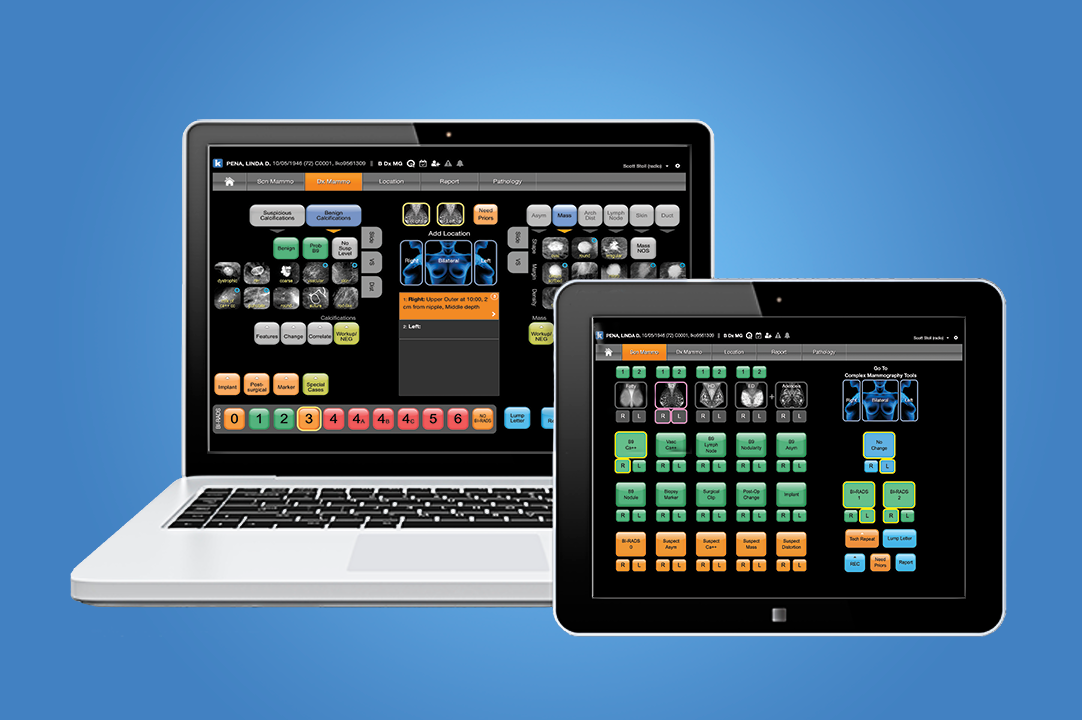
Unlike a general EHR imaging module, Ikonopedia delivers breast-specific automation across reporting, risk identification, patient communication, and follow-up tracking.
Tracking of Every Lesion
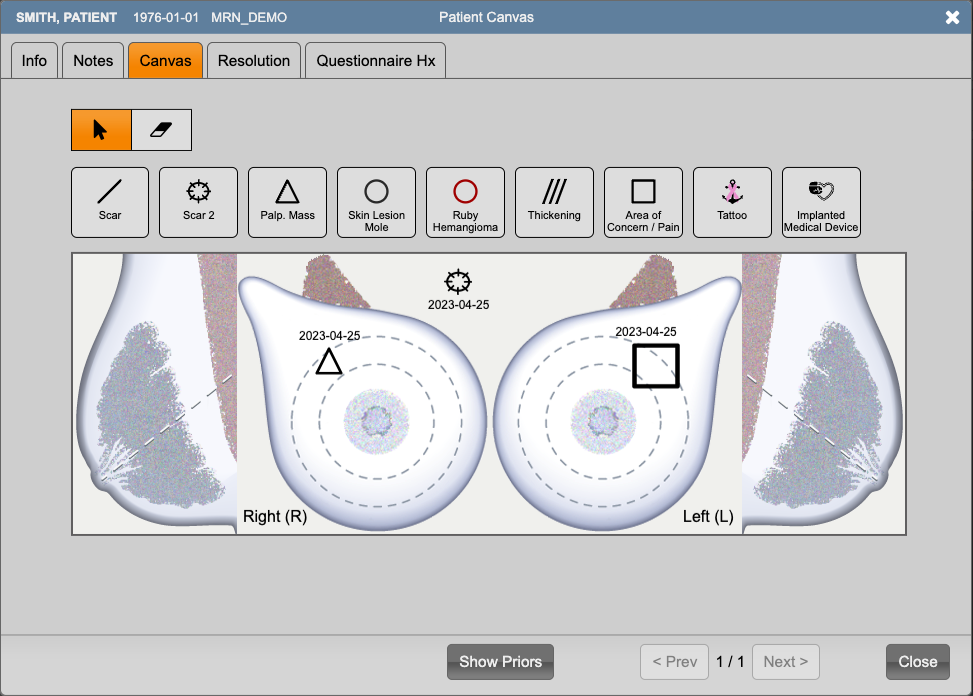
Not per breast. Not per patient. Every physician finding is individually tracked until resolved.
Automated High-Risk Identification & Risk Integration
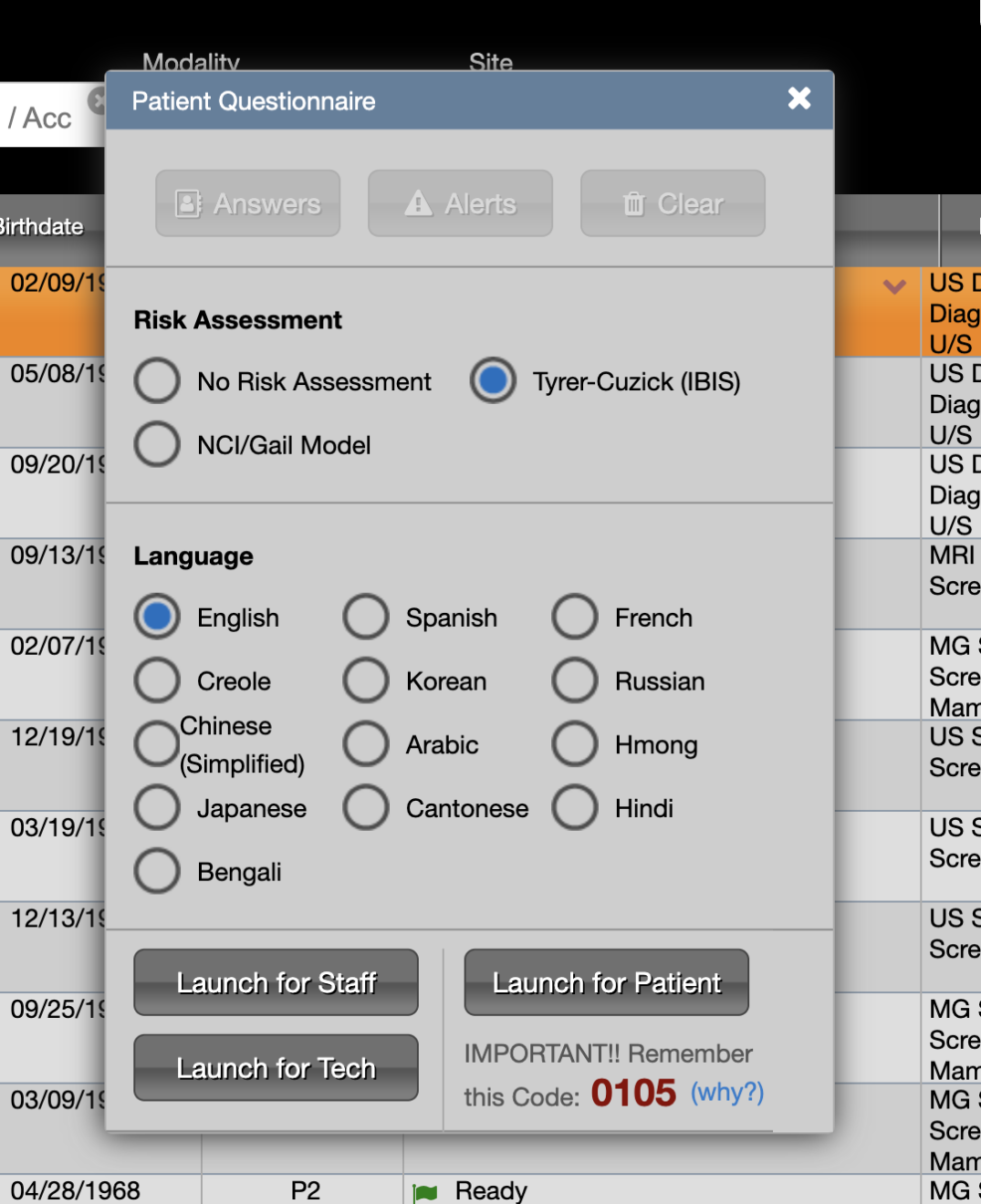
- Integration of Tyrer-Cuzick and other risk models
- Automatic inclusion of risk status in the radiologist’s report
- Automatic notification language in patient letters
- Automated tracking of high-risk recommendations
Structured Reporting Designed for Breast Imaging
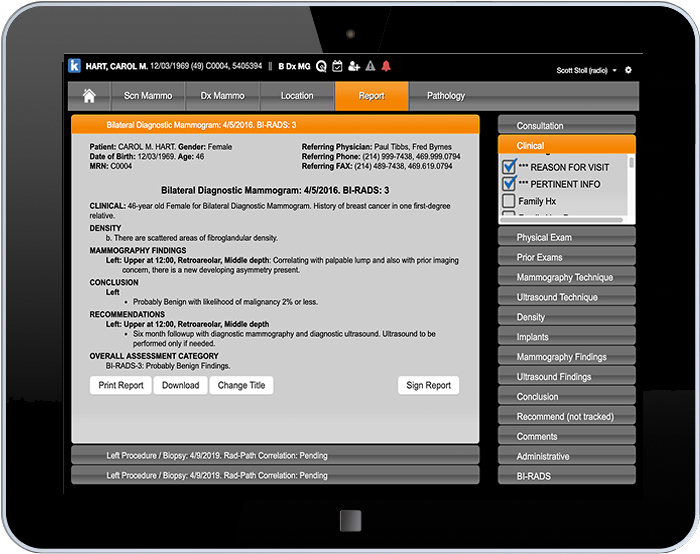
EHR workflows often rely on dropdowns plus voice recognition, increasing risk of conflicting documentation, lost recommendations, unstructured data that cannot be audited. Ikonopedia provides a complete structured workflow designed specifically for mammography, ultrasound, MRI, and contrast-enhanced mammography (CEM).
Structured Reporting Designed for Breast Imaging
EHR workflows often rely on dropdowns plus voice recognition, increasing risk of conflicting documentation, lost recommendations, unstructured data that cannot be audited. Ikonopedia provides a complete structured workflow designed specifically for mammography, ultrasound, MRI, and contrast-enhanced mammography (CEM).
Built-In QA: “No Patient Left Behind”
Every report is automatically quality-checked. Every recommendation is monitored. Every follow-up is auditable.
Automated Patient Letters in Multiple Languages
Regulatory language updates, such as density notification requirements, are maintained centrally so clients stay compliant.
Why EHR Modules Fall Short in Breast Imaging
Enterprise EHR vendors serve broad clinical needs. They are not built to satisfy the workflow complexity of breast imaging.
Common limitations include:
- Patient-level tracking only
- Limited lesion-level auditability
- No automated high-risk tracking workflows
- Heavy local build and maintenance requirements
- Slow adaptation to evolving BI-RADS updates, density laws, EQUIP, MOD, and peer review requirements
Breast imaging standards evolve continuously. Centralized updates reduce variability and compliance exposure across markets.
Patient Safety Risks with only EHR
When lesion-level tracking is not automated to documented closure, responsibility shifts to staff.
Teams must manually:
- Review reports for secondary findings
- Cross-check recommendations against patient letters
- Track follow-up imaging in spreadsheets or work queues
- Conduct audits to confirm compliance
In high-volume breast imaging practices, manual QA is resource-intensive and inherently prone to human error.
A missed follow-up recommendation is not a minor workflow issue. It is a patient safety event.
A true closed-loop system like Ikonopedia ensures:


Without automation, each of these steps becomes a potential failure point. Ikonopedia removes those gaps and ensures no recommendation disappears within dictated text.
The Financial Reality: Ikonopedia as a Revenue Engine
Breast imaging is both a clinical imperative and a strategic growth driver.
Typical Ikonopedia investment supports financial performance:
High-Risk MRI Programs
Automated identification of high-risk patients expands screening programs that detect significantly more cancers per thousand than mammography alone.
Add-On Imaging
Structured tracking of secondary findings drives appropriate utilization of diagnostic ultrasound, contrast-enhanced mammography, MRI follow-up, and biopsy procedures.
Reduced Labor Burden
Replacing automation with manual QA oversight, as demonstrated by the 12 FTE example, introduces substantial operational cost.
Avoided Liability
Missed follow-up recommendations represent one of the highest malpractice risks in breast imaging. Closed-loop tracking reduces that exposure.
Real-World Customer Stories
We’re happy to share how our customers are benefiting by pairing Ikonopedia with their EHR, to achieve both lesion-level and patient-level tracking.
Social Media